
驻马店外国人考中国驾照英语版
2026年科目一英文版题库共973题,你可以免费查看随机20题,完整版题库请添加微信购买:

The English version of the 2026 subject 1 question bank has a total of 973 questions. You can view the top 20 questions for free. Please add WeChat to purchase the complete version of the question bank.
1. After a vehicle enters the ramp, the driver should swiftly increase the speed to more than 60 kilometers per hour.
Answer: N
2. Driving in a dusty weather, it does not needed to turn on the head light, the contour light and the tail light.
Answer: N
3. Traffic markings are divided into indication, warning and prohibition.
Answer: Y
4. When a motorized vehicle breaks down on the expressway, the driver should place a warning sign 50 meters ~ 100 meters in the coming direction.
Answer: N
5. When encountering non-motorized vehicles intending to bypass a stopping vehicle, the driver should ________.
A. Honk to indicate them to yield
B. Yield to them
C. Speed up and bypass
D. Follow them closely and honk
Answer: B
6. Driving a motorized vehicle on the expressway is not allowed to exceed the marked maximum speed.
Answer: Y
7. When running on an expressway that has four lanes in the same direction, the vehicles whose speed is higher than 110 kilometers per hour should run ______.
A. The far left lane
B. The second left lane
C. The far right lane
D. The third left lane
Answer: A
8. When driving at night, the drivers observation ability is visibly poorer and his visibility range becomes shorter than driving in the daytime.
Answer: Y
9. When encountering a vehicle coming in the opposite direction on a mountain road, the driver should ______ when crossing each other.
A. Not reduce speed
B. Stick to the center of the road
C. Speed up
D. Reduce speed or stop to yield
Answer: D
10. The reason that a road destroyed by flood affects safe driving and smooth passage is __.
A. The road grip becomes stronger
B. It is impossible to see the hidden holes and bumps in road surface
C. The visibility become lower and blurs the field of vision
D. The sunshine reflection blurs the view
Answer: B
11. Speeding up to go though the intersection before the light turns to red in this case.
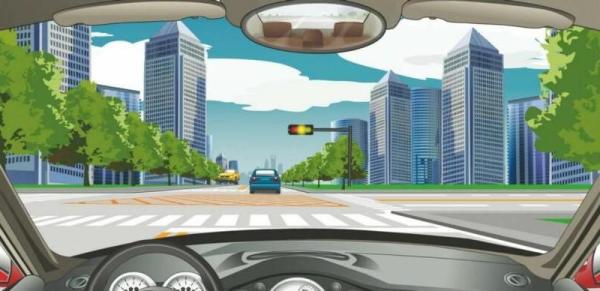
Answer: N
12. When driving in a heavy rain, the driver should control the speed to avoid the danger arising from water slide.
Answer: Y
13. In this case, if it has not begun going up the slope, the vehicle going uphill should yield to the one going downhill.
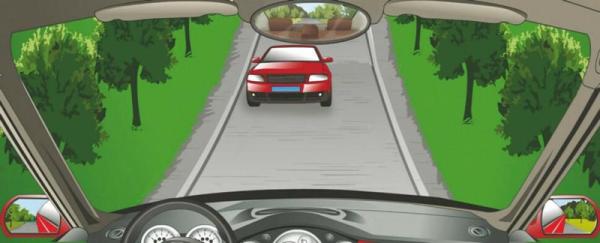
Answer: Y
14. When starting up a vehicle stopping at the roadside, the driver should first ________.
A. Depress the accelerator pedal and start
B. Honk
C. Increase engine rotation speed
D. Observe the conditions around the vehicles
Answer: D
15. When a vehicle overtakes the bike riders going in the same direction, the rational way to deal with is to ________.
A. Continuously honk to remind them to yield
B. Continuously honk and speed up to overtake
C. Yield to the bike riders
D. Observe them, reduce speed and go slowly, while keeping a sufficient safe distance.
Answer: D
16. How to pass this intersection?
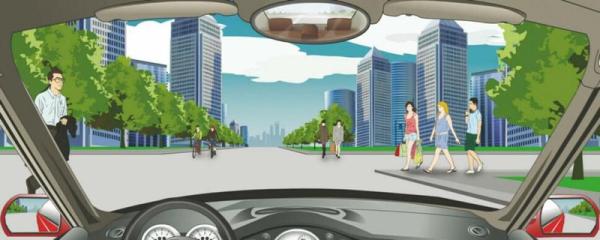
A. keep the speed and go through
B. honk to urge
C. reduce speed and go through slowly
D. speed up and go through
Answer: C
17. When encountering a vehicle in the opposite direction forcing its way by using his lane, the driver should __________.
A. Force the other side to drive by the right side
B. Use the high beam light to warn the other side
C. Voluntarily yield to the other side
D. Go ahead by the center of the road
Answer: C
18. The main impact of rainy weather on safe driving is _______.
A. The road is wet and slippery and the visibility is poor
B. The engine is prone to stop
C. The resistance to the vehicle increases
D. The electric equipment is prone to getting wet and causing short circuit
Answer: A
19. When a motorized vehicle breaks down at night, and is difficult to move, the driver should turn on the hazard lights, the contour lights and the tail lights.
Answer: Y
20. When a driver needs to borrow a lane to bypass an obstacle in front and a vehicle in the opposite direction is approaching the obstacle, the driver should ___________.
A. Reduce speed or stop and yield to the vehicle coming in the opposite direction
B. Speed up and bypass the obstacle in advance
C. Honk to indicate the vehicle in the opposite direction to yield
D. Rapidly occupy the lane and force the vehicle coming in the opposite direction to stop and yield
Answer: A
Previous: 英文题科目一
Next: 外国籍考驾照需要什么